Skip to content
Developer Business Lab
Menu

Freelance Developer Launch Kit

Build the first complete version of the freelance business around your technical skills.

Connect what you sell, what the work needs to support, how opportunities enter the business, how buyers move toward decisions, how delivery stays attached to the deal, and how the business decides what to improve next.

Best for

Independent developers who can already deliver professional client work and want that technical ability to support a stronger income, a more sustainable business, and more control over how they work.

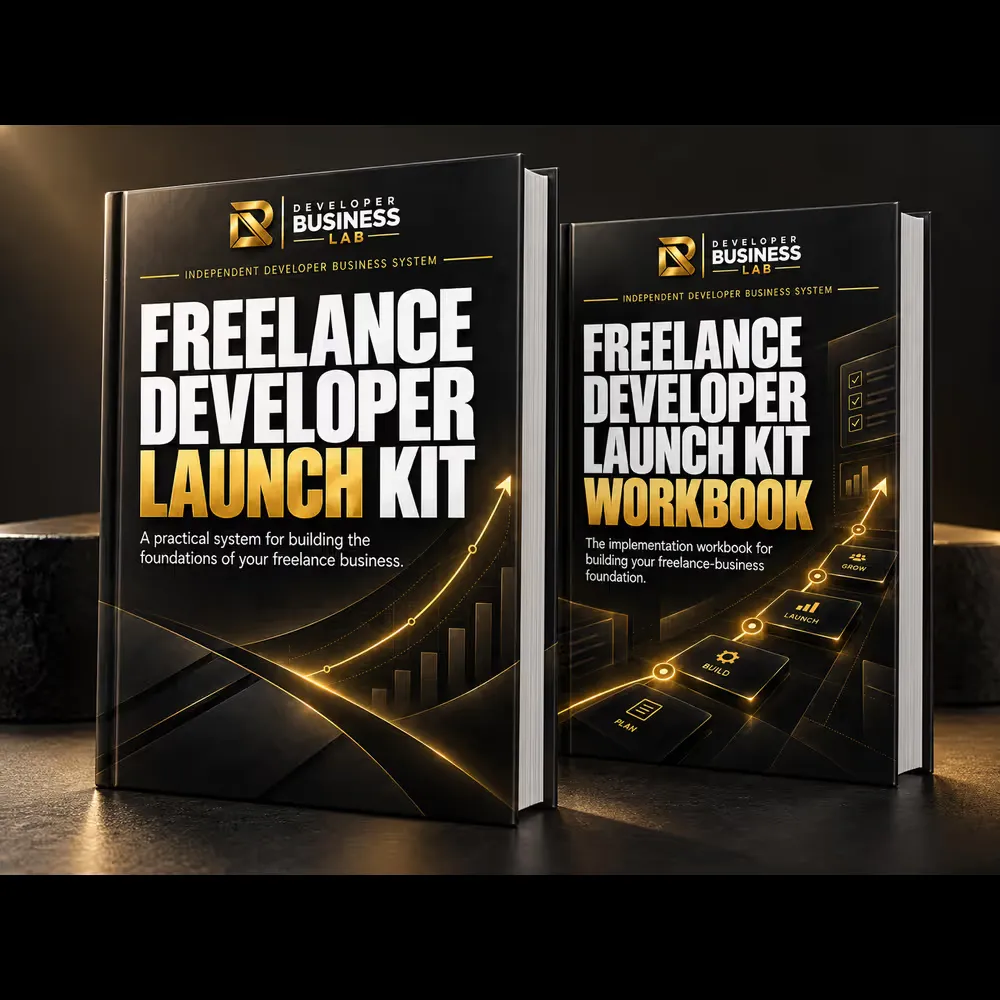
Freelance Developer Launch Kit product mockup

$129.00

one-time

138-page implementation guide + 77-page companion workbook

Covered by Developer Business Lab's 14-Day Satisfaction Guarantee.

Get the business out of your head

Build the first operating version of the business around the technical skill you already have.

You already know how to deliver professional development work. The Launch Kit helps you turn the business around that skill into something you can run instead of reconstructing from memory around every project.

When offer, pricing, acquisition, sales, delivery, cash, capacity, and future demand are handled separately, one weak month can make the whole business feel unstable even when the technical work is strong.

When the business keeps starting over

You can know how to deliver the work and still improvise almost everything around it.

Freelancing is attractive because a valuable technical skill can create options. You can earn directly from the value you deliver, choose clients and projects more deliberately, shape the schedule, work remotely, build your own reputation, and create something that belongs to you.

But technical competence does not automatically create any of that.

A developer can deliver excellent work and still price projects badly, depend on referrals, accept weak-fit clients, stop acquisition when delivery gets busy, send proposals before the opportunity is understood, absorb scope expansion, finish projects with weak margins, or reach the end of a good engagement with no next source of demand.

Those problems are connected. A better rate does not fix an unclear obligation. More outreach does not fix a weak offer. A better proposal does not repair missing discovery. More delivery process does not solve an empty pipeline. Fixing one symptom at a time can leave the business just as fragile at a different point.

Freelance Developer Launch Kit teaches the first complete commercial operating system around the technical skill you already have. You define what you are willing to sell, what the work must cover economically, how buyers find and evaluate you, how an opportunity becomes a responsible commercial decision, how delivery protects the commitment you sold, and how each cycle creates evidence for the next one.

This is not process for its own sake. It is to help you build a freelance business that can earn sustainably, protect your time and margin, create future opportunities before you need them, and give you more control over the work you choose to accept.

What ownership looks like

The business remembers what it learns.

A new inquiry arrives and you already know what kind of paid obligation you are willing to sell, what it needs to support, what has to be understood before proposal, and how the result will feed the next business decision.

Leave with the first complete operating system for turning technical capability into an independent freelance business: offer, pricing, proof, acquisition, sales, delivery, cash, capacity, future demand, and a repeatable way to improve the current constraint.

  • Define the paid obligation and the boundaries around it before pressure turns an inquiry into a commitment.
  • Know what client work needs to support economically before a price becomes a promise.
  • Keep buyer access and future opportunity alive while paid work is underway.
  • Move sufficiently understood opportunities toward a commercial decision instead of asking proposals to finish discovery.
  • Use delivery evidence, proof, cash, capacity, and future demand to decide what deserves attention next.

Guide + workbook

Build the foundation, operate it, then improve the constraint the evidence reveals.

  1. 01Understand the Business System: separate technical readiness from commercial readiness, map buyer uncertainty, and put the first operating cycle on the calendar
  2. 02Choose the Commercial Hypothesis: select a starting business model, market focus, buyer problem, desired change, and evidence cycle without treating early choices as permanent
  3. 03Define and Price the Obligation: turn capability into a bounded service, make scope observable, compare alternatives, calculate the economic floor, choose pricing logic, and protect cash and capacity
  4. 04Build Trust and Transaction Readiness: assemble honest proof, create enough buyer-facing presence for verification, and make agreements, payment, records, access, and project-start requirements operational
  5. 05Create and Manage Demand: choose an acquisition portfolio, use warm relationships and partners appropriately, decide how social media fits, run qualified outbound, and maintain a pipeline with observable next actions
  6. 06Sell by Reducing Uncertainty: investigate the buyer's situation, qualify fit, use paid discovery for material unknowns, determine proposal readiness, and move toward a clear commercial decision
  7. 07Deliver Under Controlled Risk and Create Future Demand: onboard, communicate, manage dependencies and change, verify acceptance, launch and hand off, inspect actual economics, capture proof, and evaluate legitimate repeat or recurring work
  8. 08Manage, Diagnose, and Improve: run a weekly whole-business review, separate activity from evidence and outcome, compare the first operating cycle with the starting state, identify the current constraint, and choose the next bounded action

See inside the system

See whether this is actually an operating system before you buy.

These previews show four points where the workbook turns business reasoning into a decision you can reuse: pricing an obligation, testing outbound, deciding whether an opportunity is ready to move forward, and choosing what the business should improve next. They are reconstructed from the workbook at a web-readable scale so the decision logic is visible.

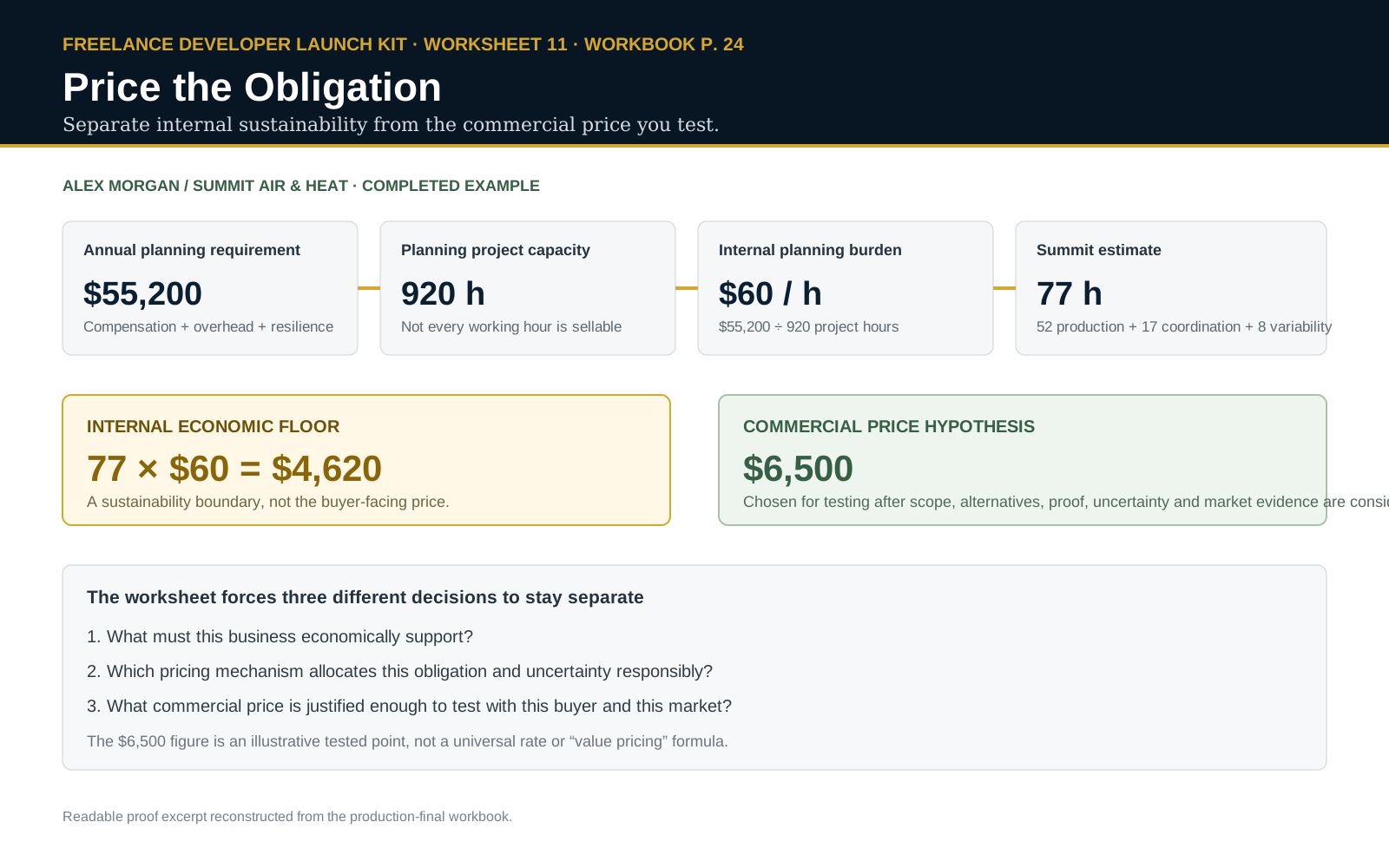
Completed Worksheet 11 pricing example showing annual economic requirement, project capacity, internal burden, 77-hour Summit estimate, 4620-dollar floor, and 6500-dollar commercial price hypothesis

Worksheet 11 · Price the Obligation · Workbook p. 24

Before Alex discusses a project price, he separates what the work must cover internally from the price he will test commercially. The worksheet derives a $4,620 planning floor from the current assumptions, compares several price hypotheses, and records what would force the engagement to be re-scoped or investigated first. The numbers are fictional case facts, not recommended rates.

Open full-size preview
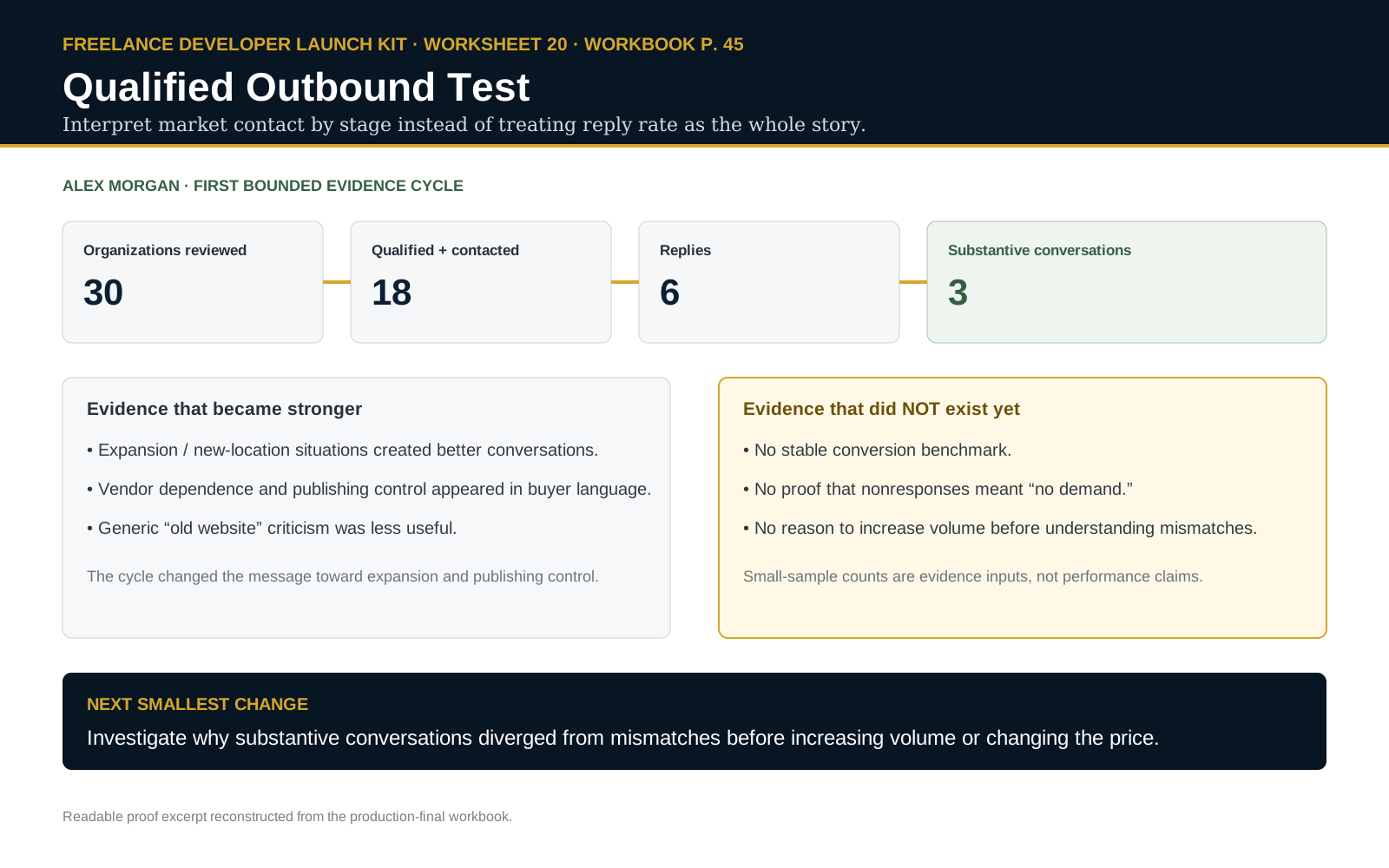
Completed Worksheet 20 evidence cycle showing 30 organizations reviewed, 18 contacted, 6 replies, 3 substantive conversations, stronger trigger evidence, unsupported conclusions, and the next smallest change

Worksheet 20 · Qualified Outbound Test · Workbook p. 45

Prospecting becomes useful when the activity teaches you something. Alex records 30 organizations reviewed, 18 contacted, 6 replies, and 3 substantive conversations, then separates what those observations support from what the small fictional sample cannot prove. The next action comes from the evidence instead of a reflex to send more volume.

Open full-size preview
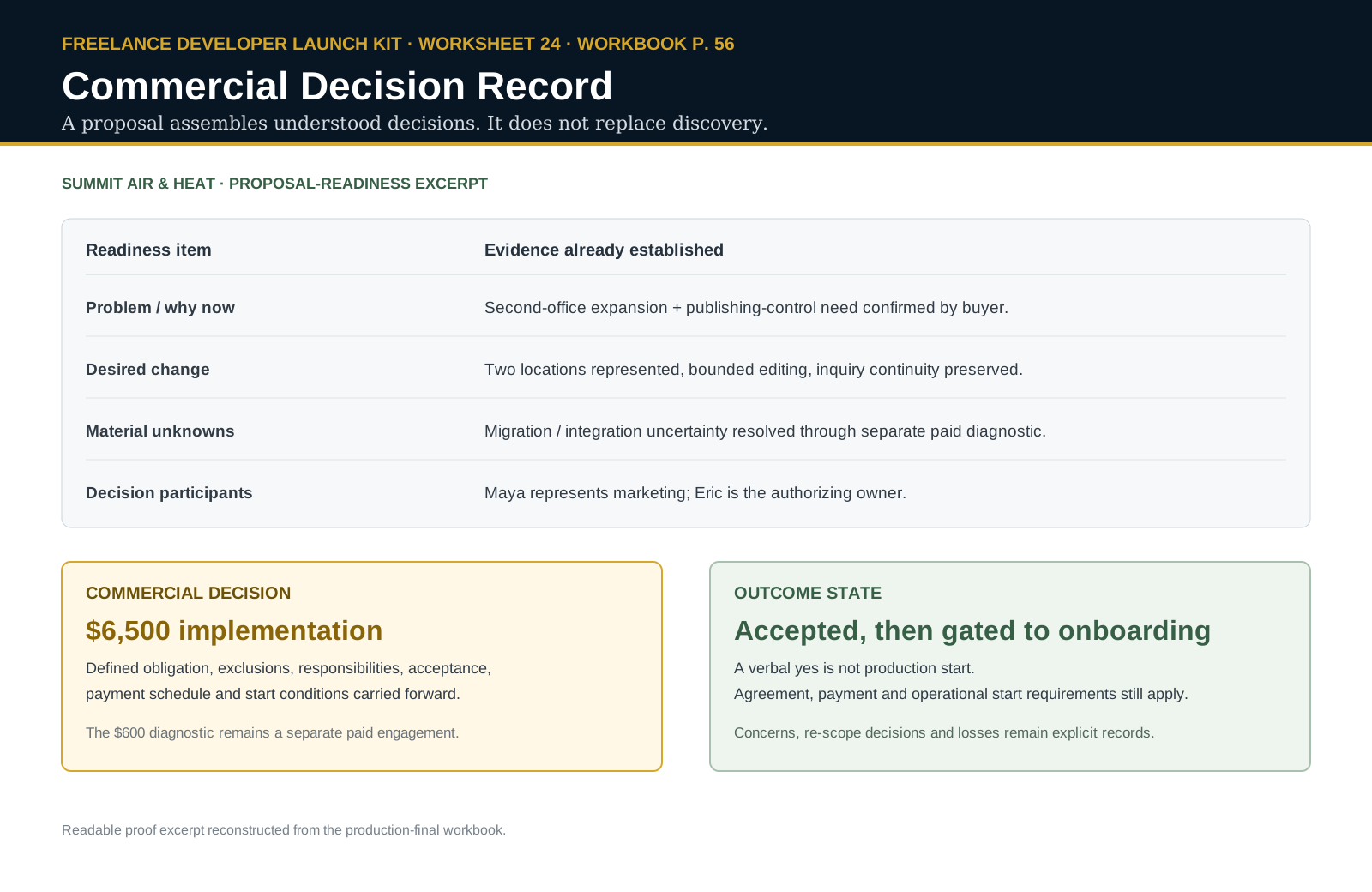
Completed Worksheet 24 commercial decision example showing buyer-confirmed problem, desired change, paid-discovery resolution, decision participants, 6500-dollar implementation, and controlled onboarding gate

Worksheet 24 · Commercial Decision Record · Workbook p. 56

The proposal is not where Alex discovers what he is selling. By this point the problem, desired change, stakeholders, material unknowns, scope, economics, acceptance conditions, and decision process have already been investigated. The worksheet shows the difference between buyer interest, a defined commercial decision, and an operationally ready project start.

Open full-size preview
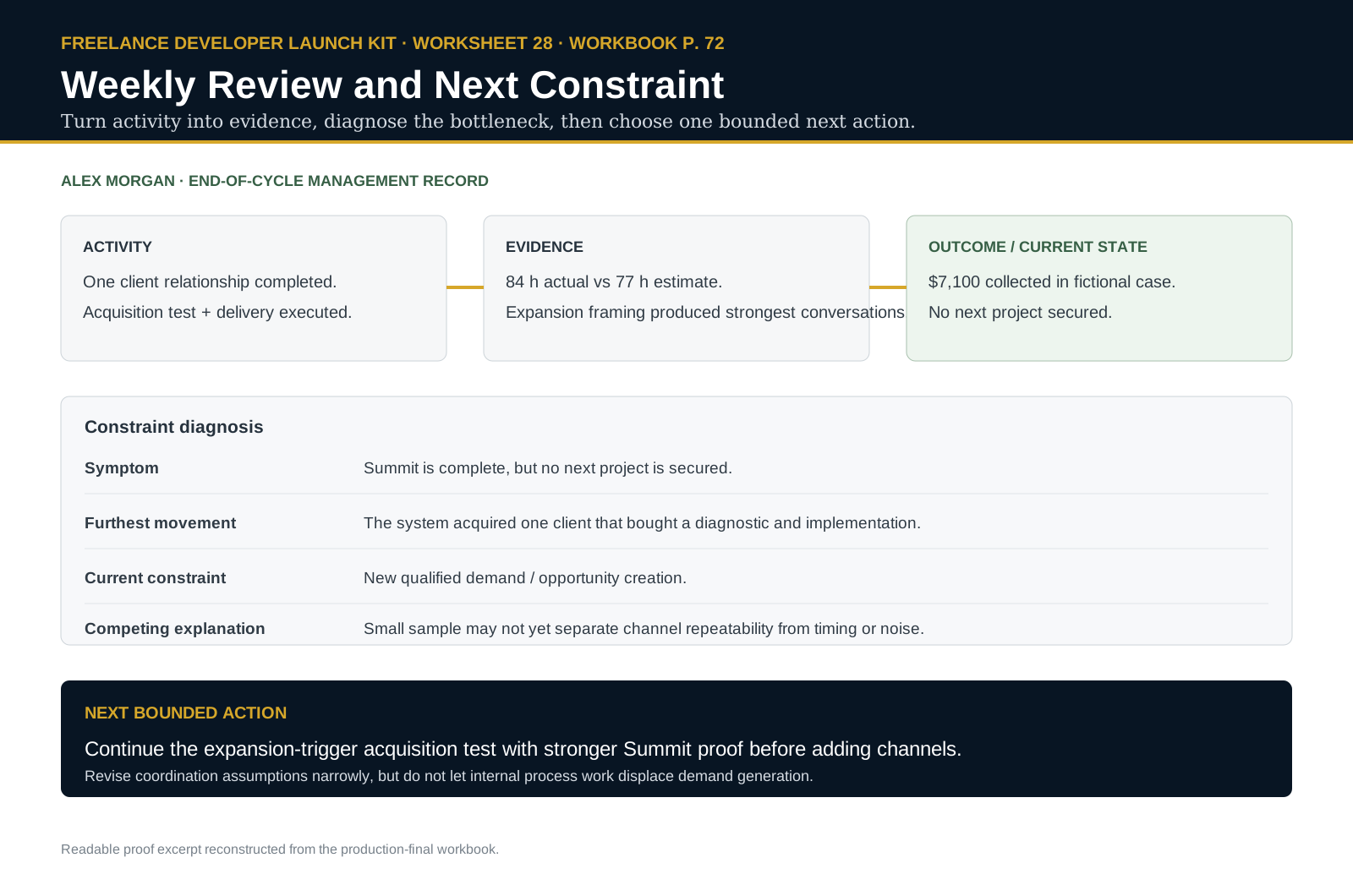
Completed Worksheet 28 management record showing activity, evidence, outcomes, constraint diagnosis, competing explanation, and the next bounded acquisition action

Worksheet 28 · Weekly Review and Next Constraint · Workbook p. 72

After delivery, the system does not automatically turn toward more internal process. Alex compares demand, cash, capacity, proof, delivery, and realized economics. The fictional Summit project took 84 hours rather than the 77-hour estimate, so coordination assumptions need revision, but the immediate business constraint is still demand. That distinction determines what receives attention next.

Open full-size preview

See the method work

Follow one developer from vague freelance capability to a controlled client engagement.

Alex Morgan is a fictional full-stack developer who can already deliver professional work but has no independent commercial system. Summit Air & Heat becomes the running buyer case. This is not to copy Alex's niche, price, or activity numbers. It is to watch the same evidence move from market hypothesis through offer, pricing, acquisition, diagnosis, commercial decision, delivery, proof, and the final constraint review.

Alex Morgan, Summit Air & Heat, the project details, activity counts, dollar figures, timing, and outcomes are fictional teaching devices used to demonstrate the operating logic. They are not customer results or market benchmarks.

  1. 01

    Choose something specific enough to test

    Alex chooses direct-client defined projects as the primary model and tests established regional home-service companies without turning that first market hypothesis into a permanent identity.

  2. 02

    Turn capability into a bounded paid obligation

    The Lead-Ready Website System becomes a defined responsibility with observable scope. Alex then derives a 77-hour provisional implementation estimate, a $4,620 internal planning floor, and a $6,500 commercial price hypothesis rather than treating one number as both cost and value.

  3. 03

    Put the hypothesis in front of real buyers

    Alex reviews 30 organizations, contacts 18, receives 6 replies, and reaches 3 substantive conversations in the fictional cycle. The useful signal is not the percentage. Expansion and publishing-control situations create better conversations than generic criticism about old websites.

  4. 04

    Investigate before pretending to know

    Summit contains material migration and integration unknowns. Instead of hiding that uncertainty inside a confident proposal, Alex uses a separate $600 paid diagnostic to resolve what could change feasibility, scope, price, or responsibility.

  5. 05

    Turn understanding into a controlled commitment

    The $6,500 implementation moves to a commercial decision only after the problem, desired state, stakeholders, scope, dependencies, acceptance, payment, and remaining uncertainty are visible. Agreement and payment still do not bypass the client-start gate.

  6. 06

    Let delivery change the next business decision

    Summit finishes at 84 implementation hours rather than the 77-hour estimate. Alex updates the coordination assumption, captures proof without inventing a lead or revenue claim, finds no justified retainer, and identifies qualified demand as the current constraint.

The useful part is not that the fictional project closes. It is that the business record survives the whole cycle. Each later decision has an upstream reason, and the final review can distinguish what needs improvement from what should be left alone for now.

The complete system

Build the business in dependency order, then let real evidence change it.

The eight parts are connected, but you do not disappear for months to finish them before contacting buyers. The operating cycle overlaps building, market contact, selling, delivery, and review so real evidence can correct assumptions while the business is still being constructed.

  1. 01Understand what the business must be able to operate and what a buyer still needs to believe
  2. 02Choose a commercial model, market hypothesis, buyer problem, desired change, and first evidence cycle
  3. 03Define the paid obligation, scope boundaries, differentiation, pricing logic, cash requirements, and capacity
  4. 04Build honest proof, enough commercial presence for verification, and transaction readiness before volume increases
  5. 05Create buyer access through a practical acquisition portfolio, relationships, appropriate social use, qualified outbound, and pipeline records
  6. 06Diagnose opportunities, use paid discovery when material unknowns require investigation, and move only sufficiently understood work toward a proposal
  7. 07Start responsibly, control communication and changes, verify completion, capture proof, inspect actual economics, and evaluate future demand
  8. 08Review the whole business, locate the current constraint, consider competing explanations, and choose one bounded next action

What you'll build

Finish with records you can use when the next buyer, project, or dry spell appears.

  • →A starting business-system record that separates the technical capability you already have from the commercial capabilities that are still missing
  • →A market and buyer hypothesis tied to observed problems, desired change, and an evidence cycle instead of a permanent niche guess
  • →A defined paid obligation and scope record with inclusions, exclusions, assumptions, dependencies, acceptance conditions, and change logic
  • →A pricing and economics record that separates internal floor, pricing mechanism, payment timing, commercial price, cash state, and capacity
  • →A proof inventory, decision-based case study, minimum commercial presence, and transaction-readiness gate
  • →An acquisition portfolio, relationship map, social-mode decision, qualified outbound test, pipeline, and qualification record
  • →A sales diagnosis record, paid-discovery decision, and commercial decision record so proposals carry understanding forward instead of replacing it
  • →A client-start gate, delivery communication record, dependency and change-control process, QA evidence, handoff record, and realized-economics review
  • →A future-demand record for proof, referrals, repeat work, partnerships, or recurring work only where actual evidence supports the next step
  • →A weekly review and current Freelance Developer Operating Specification naming the current constraint, competing explanations, next bounded action, and review point

Product depth

138

guide pages

Twenty-eight chapters covering the complete first freelance commercial system from business framing through constraint diagnosis.

77

workbook pages

A persistent operating record intended to stay useful while the business is running, not a packet of prompts completed once.

28

matched worksheets

One reader-facing worksheet for every guide chapter, each with a completed Alex / Summit example and a place to build your own record.

90

day operating cycle

A bounded management and evidence horizon for putting the system into use, reviewing evidence, and choosing the next constraint.

8

connected parts

The sequence runs from understanding the business through commercial hypothesis, economics, trust, demand, sales, delivery, and management.

Use the whole-business foundation when

  • →You can already deliver professional development work and want that skill to support a stronger, more independent livelihood
  • →You have had clients, referrals, marketplace work, or subcontracting opportunities, but income generation still depends too much on chance, habit, or one-off decisions
  • →Several parts of the freelance business interact badly enough that fixing only pricing, acquisition, sales, or delivery in isolation would miss the larger problem
  • →You want more control over clients, project economics, pipeline, workload, and future demand by building the business side as deliberately as the technical side

Use a focused system instead when

  • ×You are still learning the technical capability required to deliver the paid work itself
  • ×One specific subsystem is already clearly the constraint and the rest of the business is functioning well enough; a focused specialist product is likely the better use of your time
  • ×You already operate a mature independent business with stable demand, controlled delivery, reliable economics, and established management systems

This guide is included in a larger system

Need the rest of this stage working with it?

The Launch Kit gives you the integrated operating system. The complete Business System adds the focused specialist guides when you want to go deeper at each major stage.

Freelance Developer Launch Kit · You’re hereProductize Your Dev SkillsWeb Developer Pricing SystemMarketing for BuildersClient Acquisition Without UpworkSocial Media Client Acquisition System for FreelancersDeveloper Sales PlaybookDeveloper Proposal & Closing KitAgency Partnership PlaybookFreelancer Retainer System

Complete business

Freelance Developer Business System

Separately

$820

Bundle

$549.00

You save

$271 · 33%

Questions before you buy

Know the role of the Launch Kit before you choose it.

Freelance Developer Launch Kit

Get the business out of your head and into something you can run.

Know what you are willing to sell, what the work needs to support, how buyer access continues while you deliver, what makes an opportunity ready for commitment, and what the business should improve next.

You receive
138-page implementation guide + 77-page companion workbook
Delivery
Digital delivery through Lemon Squeezy after checkout.